Trustworthy AI for Healthcare
Preferred name: Shawn
I’m a PhD candidate at Drexel University, advised by Prof. Christopher C. Yang in the Health Informatics Research Lab.
Before joining Drexel, I earned my M.S. from the University of Pittsburgh, advised by Prof. Peter Brusilovsky, and my B.E. from Shanghai Normal University.
Research
Clinical AI can be accurate on average yet still fail the patients who need it most — by being unfair, opaque, or confidently wrong. My research targets these failure modes across three connected directions: fair and interpretable prediction, multimodal patient modeling, and reliable medical agents. Currently, my dissertation asks when multi-agent LLM systems in medicine deserve our trust: when they agree, do they actually reason alike?
Fairness & Explainability
I develop learning and optimization methods that make clinical prediction more equitable across demographic groups while preserving predictive performance. This work includes multi-attribute fairness IEEE ICHI 2025, reconciling fairness and accuracy gradients AIME 2025, fairness-aware transfer learning IEEE Access, and explainable prediction for sepsis mortality and treatment completion.
Multimodal Learning
Patients rarely present as a single data type. My multimodal work builds robust representations from whatever combination of modalities is available: MoE-Health ACM BCB 2025 routes heterogeneous health data through a mixture-of-experts design, and DeepSelective Pattern Recognition pairs feature selection with compression so EHR prognosis models stay interpretable.
Medical Agents
When a panel of LLM agents agrees on an answer, should we believe it? My work builds medical agent systems and probes exactly that question: MediHive J Healthc Inform Res coordinates specialized agents without a central controller, The Consistency Illusion shows that debate can align answers while reasoning quietly drifts apart, and a collaborative multi-agent architecture ACM BCB 2025 detects clinical problems from SOAP notes.
News
- 2026.09: 🎉 A paper accepted by IEEE Journal of Biomedical and Health Informatics (J-BHI).
- 2026.08: 🎉 A Main Conference paper accepted by Empirical Methods in Natural Language Processing (EMNLP 2026).
- 2026.08: ⛳ Successfully defended the Ph.D. Dissertation Proposal at Drexel University.
- 2026.06: ✈️ Attended IEEE ICHI 2026 in Minneapolis, MN and delivered a presentation.
- 2026.05: 🎉 A paper accepted by AMIA 2026 Annual Symposium.
- 2026.05: 🎉 A paper accepted by Journal of Healthcare Informatics Research.
- 2026.01: 🎉 A paper accepted by the 14th IEEE International Conference on Health Informatics (IEEE ICHI’26).
- 2025.12: 🎉 A paper accepted by Pattern Recognition.
- 2025.11: ✈️ Attended the AMIA Annual Symposium 2025 in Atlanta, GA.
- 2025.10: 🚶 Attended ACM BCB 2025 in Philadelphia, PA and delivered a presentation.
- 2025.08: 🎉🎉 Two papers accepted by the 16th ACM Conference on Bioinformatics, Computational Biology, and Health Informatics (ACM BCB’25).
- 2025.07: 🎉 A paper accepted by IEEE Transactions on Information Forensics & Security.
- 2025.06: 👨🏻💻 Attended IEEE ICHI’25 & AIME’25 (both in Italy 🇮🇹) and presented remotely 🥹.
- 2025.04: 🎉 A paper accepted by the 23rd International Conference on Artificial Intelligence in Medicine (AIME’25).
- 2025.01: 🎉🎉 Two papers accepted by the 13th IEEE International Conference on Health Informatics (IEEE ICHI’25).
Earlier news
- 2024.12: ⛳ Successfully passed the Ph.D. candidacy examination at Drexel University.
- 2024.07: ✈️ Attended AIME’24 in Salt Lake City, UT 🩼 and delivered a presentation.
- 2024.06: ✈️ Attended IEEE ICHI’24 in Orlando, FL and delivered a presentation.
- 2024.04: 🎉 A paper accepted by the 22nd International Conference on Artificial Intelligence in Medicine (AIME’24).
- 2024.03: 🎉 A paper accepted by the 12th IEEE International Conference on Health Informatics (IEEE ICHI’24).
Publications
* Equal contribution.
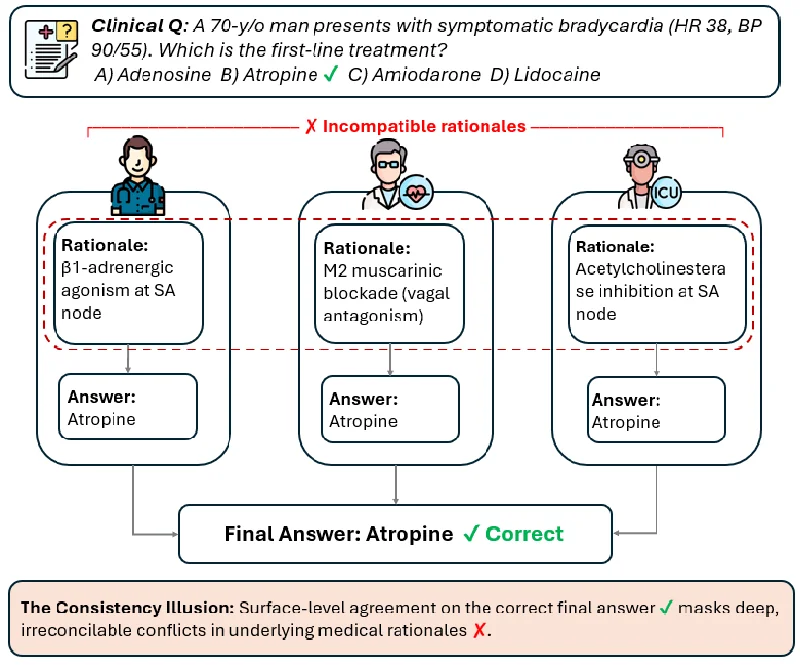
The Consistency Illusion: How Multi-Agent Debate Hides Reasoning Misalignment
Xiaoyang Wang, Christopher C. Yang.
- This work introduces CARA (Cross-Agent Reasoning Alignment), a family of metrics that tests whether multi-agent LLMs which agree on an answer also share compatible reasoning, revealing a consistency illusion in which debate suppresses agent contradictions while their reasoning chains grow less similar.
- It proposes the Grounded Debate Protocol (GDP), a lightweight prompt-level intervention that substantially improves cross-agent reasoning alignment across two medical QA benchmarks and two model backbones without adding any LLM calls.
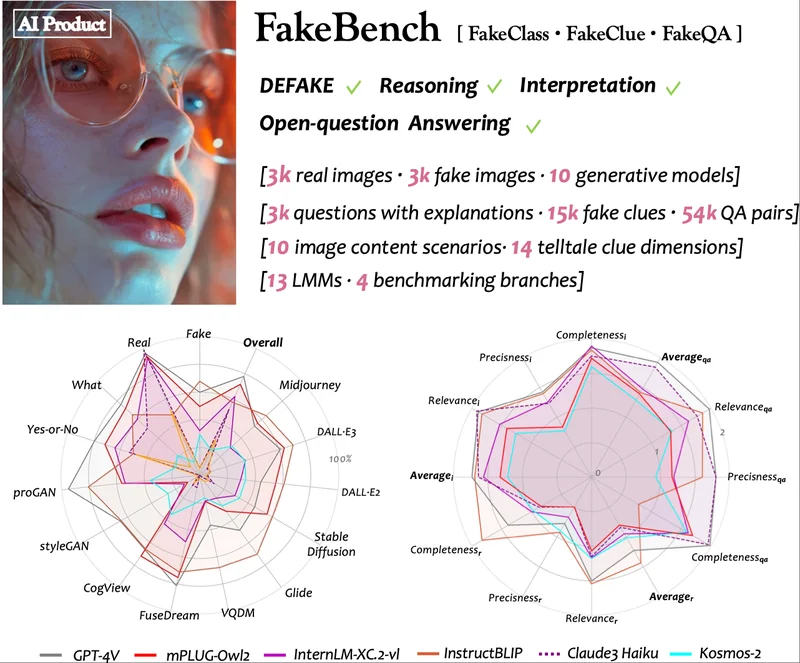
FakeBench: Probing Explainable Fake Image Detection via Large Multimodal Models
Yixuan Li, Xuelin Liu, Xiaoyang Wang, Bu Sung Lee, Shiqi Wang, Anderson Rocha, and Weisi Lin.
- This work introduces FakeBench, a multimodal benchmark designed to evaluate large multimodal models (LMMs) on explainable fake image detection rather than simple binary classification.
- The benchmark incorporates a fine-grained taxonomy of generative visual forgeries and human-in-the-loop textual descriptions to assess detection, reasoning, interpretation, and detailed forgery analysis.
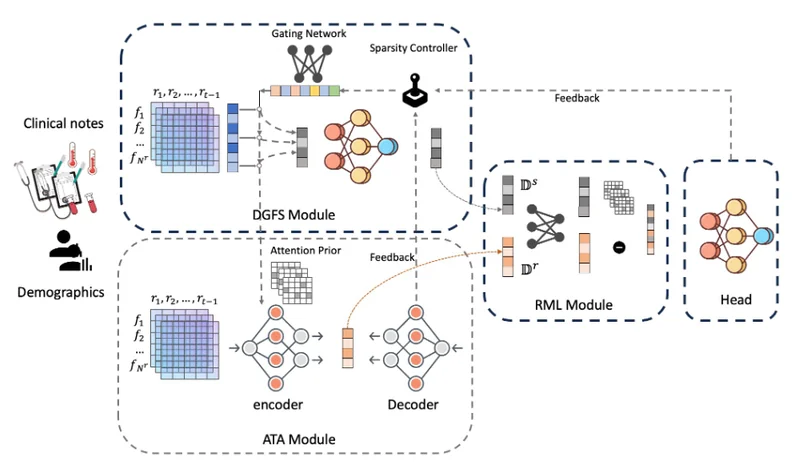
DeepSelective: Interpretable Prognosis Prediction via Feature Selection and Compression in EHR Data
Ruochi Zhang, Qian Yang, Xiaoyang Wang, Tian Wang, Qiong Zhou, Ziqi Deng, Kewei Li, Yueying Wang, Yusi Fan, Jiale Zhang, Lan Huang, Chang Liu, Fengfeng Zhou.
- This work proposes DeepSelective, a novel end to end deep learning framework for predicting patient prognosis using EHR data, with a strong emphasis on enhancing model interpretability.
- DeepSelective combines data compression techniques with an innovative feature selection approach, integrating custom-designed modules that work together to improve both accuracy and interpretability.
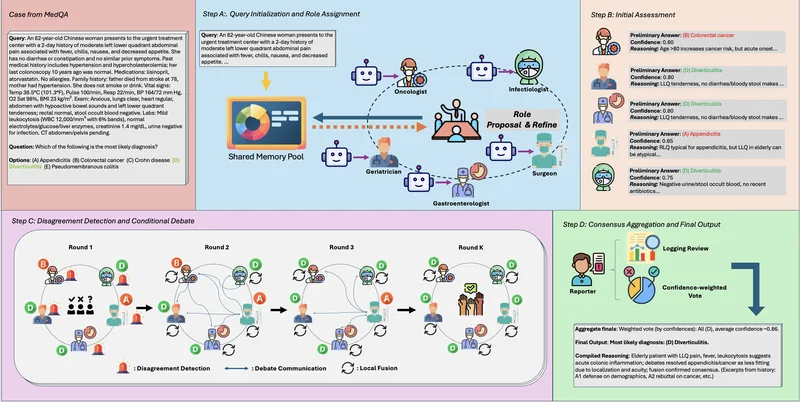
MediHive: A Decentralized Agent Collective for Medical Reasoning
Xiaoyang Wang, Christopher C. Yang.
- MediHive is a decentralized multi-agent framework for medical question answering, in which LLM-based agents self-assign specialized roles, resolve disagreements through conditional evidence-based debate, and iteratively fuse peer insights via a shared memory pool to reach consensus without any central coordinator.
-
EMNLP 2026 The Consistency Illusion: How Multi-Agent Debate Hides Reasoning Misalignment
-
IEEE TIFS FakeBench: Probing Explainable Fake Image Detection via Large Multimodal Models
-
Pattern Recognition DeepSelective: Interpretable Prognosis Prediction via Feature Selection and Compression in EHR Data
-
J Healthc Inform Res MediHive: A Decentralized Agent Collective for Medical Reasoning
-
AMIA 2026 Strategy-Guided Multi-Agent Debate for Medical Question Answering
-
IEEE JBHI FairMoE-Health: Fairness-Aware Mixture of Experts for Equitable Multimodal Clinical Prediction
-
ACM BCB 2025 MoE-Health: A Mixture of Experts Framework for Robust Multimodal Healthcare Prediction
-
ACM BCB 2025 Automated Clinical Problem Detection from SOAP Notes using a Collaborative Multi-Agent LLM Architecture
-
IEEE ICHI 2025 Enhancing Multi-Attribute Fairness in Healthcare Predictive Modeling
-
AIME 2025 Balancing Fairness and Performance in Healthcare AI: A Gradient Reconciliation Approach Top 6% Oral
-
AIME 2024 Explainable AI for Fair Sepsis Mortality Predictive Model
-
IEEE ICHI 2024 An ExplainableFair Framework for Prediction of Substance Use Disorder Treatment Completion
-
IEEE Access Achieving Equity via Transfer Learning with Fairness Optimization
@article{wang2026consistencyillusion,
  title   = {The Consistency Illusion: How Multi-Agent Debate Hides Reasoning Misalignment},
  author  = {Wang, Xiaoyang and Yang, Christopher C.},
  journal = {arXiv preprint arXiv:2606.08457},
  year    = {2026}
}
@article{li2025fakebench,
  title   = {FakeBench: Probing Explainable Fake Image Detection via Large Multimodal Models},
  author  = {Li, Yixuan and Liu, Xuelin and Wang, Xiaoyang and Lee, Bu Sung and Wang, Shiqi and Rocha, Anderson and Lin, Weisi},
  journal = {IEEE Transactions on Information Forensics and Security},
  year    = {2025},
  doi     = {10.1109/TIFS.2025.3597211}
}
@article{zhang2026deepselective,
  title   = {DeepSelective: Interpretable Prognosis Prediction via Feature Selection and Compression in EHR Data},
  author  = {Zhang, Ruochi and Yang, Qian and Wang, Xiaoyang and Wang, Tian and Zhou, Qiong and Deng, Ziqi and Li, Kewei and Wang, Yueying and Fan, Yusi and Zhang, Jiale and Huang, Lan and Liu, Chang and Zhou, Fengfeng},
  journal = {Pattern Recognition},
  year    = {2026},
  doi     = {10.1016/j.patcog.2025.112970}
}
@article{wang2026medihive,
  title   = {MediHive: A Decentralized Agent Collective for Medical Reasoning},
  author  = {Wang, Xiaoyang and Yang, Christopher C.},
  journal = {Journal of Healthcare Informatics Research},
  year    = {2026},
  doi     = {10.1007/s41666-026-00239-7}
}
@inproceedings{wang2026strategy,
  title     = {Strategy-Guided Multi-Agent Debate for Medical Question Answering},
  author    = {Wang, Xiaoyang and Yang, Christopher C.},
  booktitle = {AMIA Annual Symposium Proceedings},
  year      = {2026},
  note      = {To appear}
}
@article{wang2026fairmoehealth,
  title   = {FairMoE-Health: Fairness-Aware Mixture of Experts for Equitable Multimodal Clinical Prediction},
  author  = {Wang, Xiaoyang and Yang, Christopher C.},
  journal = {IEEE Journal of Biomedical and Health Informatics},
  year    = {2026}
}
@inproceedings{wang2025moehealth,
  title     = {MoE-Health: A Mixture of Experts Framework for Robust Multimodal Healthcare Prediction},
  author    = {Wang, Xiaoyang and Yang, Christopher C.},
  booktitle = {Proceedings of the 16th ACM Conference on Bioinformatics, Computational Biology, and Health Informatics (ACM BCB)},
  year      = {2025}
}
@inproceedings{lee2025automated,
  title     = {Automated Clinical Problem Detection from SOAP Notes using a Collaborative Multi-Agent LLM Architecture},
  author    = {Lee, Yeawon and Wang, Xiaoyang and Yang, Christopher C.},
  booktitle = {Proceedings of the 16th ACM Conference on Bioinformatics, Computational Biology, and Health Informatics (ACM BCB)},
  year      = {2025}
}
@inproceedings{wang2025multiattribute,
  title     = {Enhancing Multi-Attribute Fairness in Healthcare Predictive Modeling},
  author    = {Wang, Xiaoyang and Yang, Christopher C.},
  booktitle = {Proceedings of the 13th IEEE International Conference on Healthcare Informatics (ICHI)},
  year      = {2025}
}
@inproceedings{wang2025balancing,
  title     = {Balancing Fairness and Performance in Healthcare AI: A Gradient Reconciliation Approach},
  author    = {Wang, Xiaoyang and Yang, Christopher C.},
  booktitle = {Artificial Intelligence in Medicine (AIME)},
  year      = {2025},
  doi       = {10.1007/978-3-031-95838-0_47}
}
@inproceedings{chang2024explainable,
  title     = {Explainable AI for Fair Sepsis Mortality Predictive Model},
  author    = {Chang, Chia-Hsuan and Wang, Xiaoyang and Yang, Christopher C.},
  booktitle = {Artificial Intelligence in Medicine (AIME)},
  year      = {2024}
}
@inproceedings{lucas2024explainablefair,
  title     = {An ExplainableFair Framework for Prediction of Substance Use Disorder Treatment Completion},
  author    = {Lucas, Mary M. and Wang, Xiaoyang and Chang, Chia-Hsuan and Yang, Christopher C.},
  booktitle = {Proceedings of the 12th IEEE International Conference on Healthcare Informatics (ICHI)},
  year      = {2024}
}
@article{wang2024achieving,
  title   = {Achieving Equity via Transfer Learning with Fairness Optimization},
  author  = {Wang, Xiaoyang and Chang, Chia-Hsuan and Yang, Christopher C.},
  journal = {IEEE Access},
  year    = {2024},
  doi     = {10.1109/ACCESS.2024.3519465}
}
Background
Education



Honors & Awards
-
The Institute for Healthcare Informatics (IHI) Student Award 2026
-
AIME 2025 Student Scholar Award 2025
-
IEEE ICHI 2025 Student Scholar Award 2025
-
Merit Student Researcher Scholarship, Chinese Academy of Sciences 2017
-
Second Prize Merit Scholarship, Shanghai Normal University 2016
Academic Service
- Journal Reviewer: JAMIA, J Healthc Inform Res, IEEE TIFS, IP&M, ACM HEALTH, MedIA, and Comput Electr Eng.
- Conference Reviewer: NeurIPS 2024, AAAI 2025, ICLR 2025, ICWSM 2025, IEEE ICHI 2025 & 2026, WWW 2026, IEEE ICME 2026, and Digital Twins for Health Society (DT4HS).
Teaching Experience
Teaching Assistant · Drexel University
-
INFO 103Introduction to Data ScienceWinter & Spring 2026
-
INFO 152Web Systems & Services IISpring 2026
-
INFO 250Information VisualizationSpring 2026
-
INFO 623Social Network AnalysisSpring 2026
-
INFO 212Data Science Programming IFall 2024
Teaching Assistant · Shanghai Normal University
-
Digital SwitchingSpring 2017
Visitor Map

Hello, world!
Thanks for visiting. I am open to collaborations on trustworthy AI for healthcare, multimodal learning, and multi-agent systems. Feel free to get in touch.